
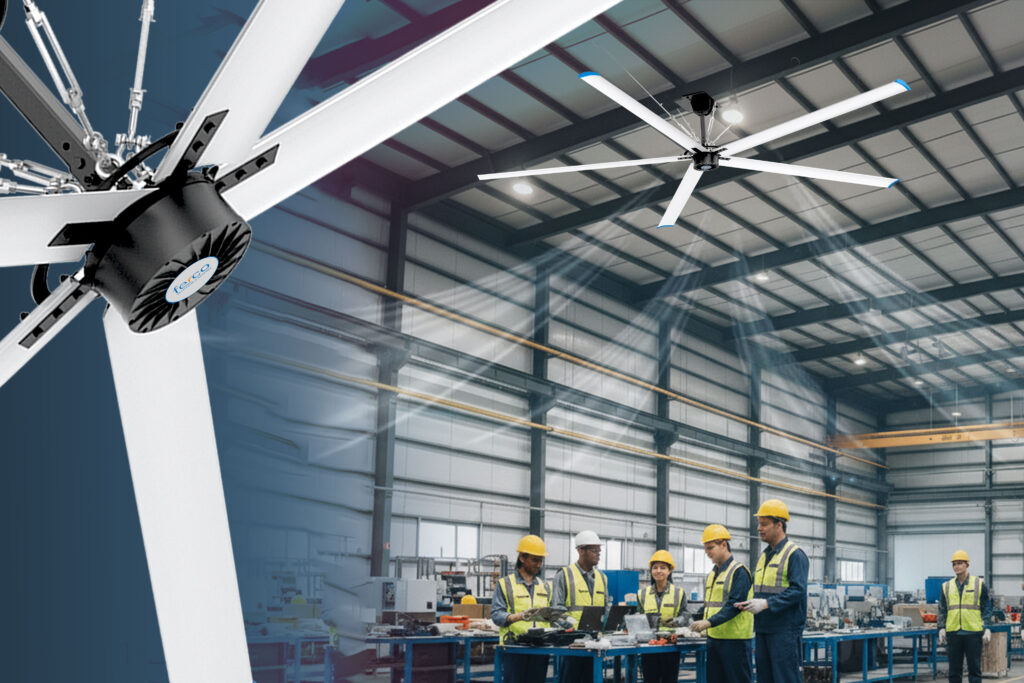
HVLS Fans (High-Volume, Low-Speed Fans) are modern industrial ceiling fans designed to move large volumes of air efficiently across wide spaces. These fans are excellent alternatives to wall-mounted fans, as they evenly distribute air throughout the area. The principle of an HVLS Fan is simple but highly effective. With blade sizes ranging from 8 feet to 24 feet in diameter, these high-volume, low-speed fans push down a massive column of air, ensuring effective air movement and comfort.
How an HVLS Fan Works in Real Time
Here’s what happens in real time:
- Rotation Begins – The industrial ceiling fan starts rotating slowly — typically less than 75 RPM. Even though the speed is low, the large blades are designed to move an enormous volume of air.
- Formation of the Air Column – As the blades spin, they push a column of air downward toward the floor. This is known as the air column effect, and it’s the core principle of how an HVLS fan works.
- Air Spreads Outward – When the air column hits the floor, it spreads out horizontally in all directions. This creates a wide, gentle breeze that can travel across the entire facility.
- Airflow Circulation Across the Space – The outward-moving air gradually rises along the walls and other surfaces, where it gets pulled back into the circulation zone of the fan. This creates a continuous cycle of airflow circulation.
- Cooling Effect in Summer – The breeze generated by the high-volume, low-speed fan increases the rate of evaporation on human skin, making people feel cooler without changing the actual temperature. This reduces the need for heavy air conditioning, cutting energy bills significantly.
- Warming Effect in Winter – In reverse mode, the fan gently pulls warm air trapped at the ceiling back down to the floor. This eliminates cold spots and helps maintain an even temperature, lowering heating costs.
Key Functions During Operation
- Cooling Effect – Creates an instant cooling effect in areas where air circulation is poor. Reduces the need for heavy air conditioning inside the property.
- Large Warehouse Fan Capability – With its wide coverage area, a single HVLS Fan can replace several traditional ceiling fans for ultimate comfort and energy savings.
- Quiet Operation – HVLS Fans operate quietly, making them perfect for noise-sensitive environments such as places of worship, schools, and colleges.
- Low Maintenance – HVLS Fans require minimal maintenance compared to traditional ceiling fans and have a long lifespan, reducing overall operating costs.
Applications of HVLS Fans
- Industrial Facilities – Keeps factories ventilated and maintains lower temperatures for worker comfort.
- Warehouses & Logistics Centers – Distributes airflow evenly, protecting goods and reducing HVAC costs.
- Commercial Spaces – Ideal for malls, gyms, auditoriums, indoor sports complexes, places of worship, and large retail stores.
In Summary
In real time, an HVLS Fan works by creating a downward air column, spreading it across the floor, and recycling it in a continuous loop — delivering powerful comfort and cost savings every year.
Built with a lightweight motor, eco-friendly design, and moisture-proof body, HVLS Fans are the ultimate solution for efficient large-space ventilation.
Lorem ipsum dolor sit amet, consectetur adipiscing elit. Ut elit tellus, luctus nec ullamcorper mattis, pulvinar dapibus leo.